Sunday, 30 July 2017

Kerry jets in as US dispatches largest team of poll observers;30.7.2017

By WALTER MENYA
More by this Author
Former US Secretary of State John Kerry. FILE PHOTO | AFPFormer US Secretary of State John Kerry. FILE

Summary

  • With 67 accredited observers, the US government has the highest number of those IEBC has granted clearance to monitor the elections.
  • nation of US government and US-based organisations’ teams shows that Washington will likely have the highest number of election monitors in the country at 96.
  • The EU, led by Chief Observer Marietje Schaake, have warned of a possibility of post-election violence.
  • Kenya’s Elections Observation Group (Elog) says it is not fully satisfied with the state of preparedness by IEBC.
Former US Secretary of State John Kerry is expected in the country any day this week to monitor the elections as final preparations get into high gear.
Mr Kerry will be leading the US Observer Mission as well as being the co-leader of the Carter Centre, a non-profit organisation founded by former US President Jimmy Carter.
His arrival will most likely coincide with the delivery of the presidential ballot papers which are expected between tomorrow and Tuesday.
Nation has also learnt that the Independent Electoral and Boundaries Commission (IEBC) has accredited some 212 non-African observers who will observe the August 8 polls.
With 67 accredited observers, the US government has the highest number of those IEBC has granted clearance to monitor the elections.
The number is three times that of the European Union delegation which will deploy some 22 people to monitor the elections.
ELECTION OBSERVERS
Other non-African observers are Australia, Denmark, Ireland, Finland, Germany, Canada, Switzerland, Great Britain, Norway, Austria, The Kingdom of the Netherlands, Belgium, Sweden, France, Japan, US-based National Democratic Institute (NDI) and the Carter Centre.
The African Union, the regional political and trading blocs as well as individual African countries and Kenyan-based groups are also expected to have teams on the ground to observe the elections. The AU team which has been in the country is led by former South African president Thabo Mbeki.
A combination of US government and US-based organisations’ teams shows that Washington will likely have the highest number of election monitors in the country at 96.
According to IEBC Handbook for Observers, election observers are accredited to “cover the entire process from the beginning to the end, including the pre-election period, the Election Day and the post-election period.”
CARTER
“It is encouraged that coverage of an observer mission should be as broad as possible, with sufficient observers stationed throughout the country,” IEBC states.
The checklist for observers include administration and functioning of the electoral process, legal and institutional framework for the electoral process and political context and climate in which the election is held.
Already, the EU and Carter observer teams have given their assessment of the period leading to the August 8 polls.
The EU, led by Chief Observer Marietje Schaake, have warned of a possibility of post-election violence.
“There are concerns about possible eruption of violence as Kenya head to the polls,” Ms Schaake said during the official launch of the EU election observer mission early this month.
VIOLENCE
She added that Kenyan institutions have a special role in this election to ensure acts of violence are dealt with.
On the other hand, the Carter Centre has given a largely positive assessment of IEBC and the legal preparedness.
Meanwhile, Kenya’s Elections Observation Group (Elog) says it is not fully satisfied with the state of preparedness by IEBC.
Elog national co-ordinator Mulle Musau told Nation that IEBC could have done better in terms of voter education.
“We should have expected a more robust voter education and public engagement. Indeed in these last days before the elections, the voter education should be narrowed down to voter information,” he said.

Friday, 28 July 2017

Kenya election: BBC targeted by fake news; 28.07.2017

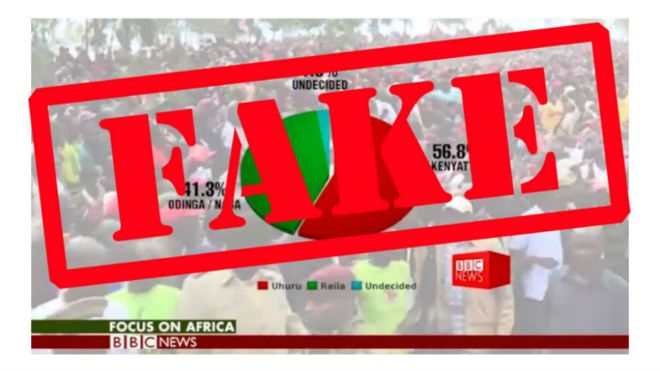
A fake video report about Kenya's election that is made to appear as if it is from the BBC's Focus on Africa programme has been circulating on social media.
'Fake' stamp over screengrab of reportThe report contains a bogus poll indicating that President Uhuru Kenyatta will win August's election.
The BBC has urged Kenyans to verify stories by visiting the BBC website.
recent survey suggested that 90% of Kenyans had seen or heard false news in the run-up to the poll.
Many of the people surveyed felt that some news items had been deliberately misleading.
It also found that while traditional media remained the most trusted source of information, large numbers of people got their news from Facebook and WhatsApp.

Check the stories

The origin of the fake BBC news story is not clear but it began to be shared on WhatsApp on Friday morning.
A fake report made to look as if it came from CNN has also been circulating.
The presidential election on 8 August will see incumbent President Kenyatta run against seven candidates including his main challenger, opposition leader Raila Odinga.

Wednesday, 26 July 2017

Why naming of Kenya’s 44th tribe should not be trivialised; 26.07.2017

By JAINDI KISERO
More by this Author
Acting Interior Cabinet Secretary Fred Matiang'i on July 22, 2017 presents a charter to Kenyans of Indian decent, recognising them as the 44th tribe in Kenya. PHOTO | ANTHONY OMUYA | NATION MEDIA GROUPĀ 
Acting Interior Cabinet Secretary Fred Matiang'i on July 22, 2017 presents a charter to Kenyans of Indian decent, recognising them as the 44th tribe in Kenya. PHOTO | ANTHONY OMUYA | NATION MEDIA GROUP  

Summary

  • When we talk about minority rights, Kenya Asians are usually not in that equation.
  • Unlike most of us who did not decide where to be born, the Kenya Asians are from descendants of people who became Kenyan citizens by choice.
  • There is a difference between citizens by accident and citizens by choice.
You could dismiss the idea of proclaiming Kenyan Asians as the country’s 44th tribe as an empty political gesture.
For me, I choose not to trivialise the whole thing because I believe that behind the phenomenon we sometimes describe as the ‘Asian Question’ in Kenya are deep issues touching on minority rights and discrimination.
When we talk about minority rights, Kenya Asians are usually not in that equation.
We have a deeply-ingrained mindset that makes no distinction between kinship and citizenship.
Many years after independence, we are yet to embrace the concept of compatriots in our mindsets.
ASIANS
Even though we are yet to see the list of rights and benefits that the Kenya Asian will enjoy now that the community has been proclaimed as the 44th tribe of Kenya, the gesture by the government should get us thinking about the rights of this minority.
There is a difference between citizens by accident and citizens by choice.
Unlike most of us who did not decide where to be born, the Kenya Asians are from descendants of people who became Kenyan citizens by choice.
Indeed, at independence, you were allowed to choose between being a Kenyan citizen and a citizen of the UK.
The period between 1963 and 1969 will go down in our history as the time when the Kenya Asian businesspeople endured most blatant cases of injustice by the political elite.
AFRICANISATION
In the name of the policy of Africanisation, Asians were given quit notices from their businesses and their shops allocated, by “provincial allocation committees”, chaired by provincial commissioners, to local oligarchs.
Under the 1967 Trade Licensing Act, provincial allocation committees literally banned Asians from operating shops in rural areas and in non-central of major towns.
The populists of the day, the likes of the late Butere MP Martin Shikuku made political careers stoking resentment against a minority they often dismissed as paper citizens.
During the era of price controls, no Budget speech would happen without a major swoop on shops owned by Asians, conducted, ostensibly to flush out greedy merchants and hoarders.
This history is what has over the years turned this minority into a politically docile group of citizens prepared to endure injustice with servility.
INJUSTICES
Although the minority represents an economically critical segment of the population, you rarely find them represented within the state apparatus, the civil service bureaucracy, the police, the defence forces, parastatals, and Parliament. 
But I will not pen off on a story about the injustices this minority has endured without recounting the tribulations and predicament of a personal friend of mine, Ramesh Gupta, who used to own property around Jeevanjee Gardens within Nairobi’s central business district.
Apparently, many senior citizen Kenya Asians living in Nairobi have recently become the victims of  politically influential land scammers with an eye on very old property leases that are about to expire.
Gupta lived alone in a house in Parklands, having divorced his wife, and after his children migrated to the UK. It came as a shock to me one day when a friend called to inform me that my friend had been killed by robbers in his house.
PARKLANDS
I subsequently attended his funeral at a Hindu Temple in Parklands where I had an opportunity to interact with many of his friends.
From what I gathered there, there were several harrowing stories of cases of how senior citizens from this community are living in uncertain times over properties whose leases are about to expire.
What is my point in all this? That proclaiming Kenyan Asians as the 44th tribe will only have meaning if we start changing mindsets that regard members of this minority community as paper citizens.
We must ask ourselves the following questions: Now that they have been proclaimed as a Kenyan minority tribe, should we expect them to start being treated as other minorities, especially in terms of equal representation in public appointments?
APPOINTMENTS
Should we expect to see appointments of members of the community to the police service, permanent secretaries and teachers?
 And, no community in this country has suffered the consequences of bank failure like the ordinary man and woman from this community.
Now that they have been proclaimed as the 44th tribe of  Kenya, are we likely to see closure and quick disposal of the receiverships of banks owned by members of this community that have collapsed?
Nearly 1,800 depositors of the fallen Trust Bank have been waiting for their cash for 18 years. We should not trivialise the proclamation of Kenya Asians as the country’s 44th tribe. 
jaindikisero@gmail.com

Queries over new NHIF directive to cap medical claims; 26.07.17

By ELIZABETH MERAB
More by this Author

A patient lies in hospital in Karatina earlier in the year. The National Health Insurance Fund has indicated in a leaked internal memo that a client claim control system which will be used for pre-authorised surgeries and dialysis services is now ready for deployment in a bid to control patient claims. PHOTO | FILE | NATION MEDIA GROUP 

A patient lies in hospital in Karatina earlier in the year. The National Health Insurance Fund has indicated in a leaked internal memo that a client claim control system which will be used for pre-authorised surgeries and dialysis services is now ready for deployment in a bid to control patient claims. PHOTO | FILE | NATION MEDIA GROUP 

Summary

  • The affected benefits include surgery, specialised radiological and diagnostic services, as well as specialised laboratory tests like magnetic resonance imaging and computed tomography scans .
  • The limit controls will also affect dialysis, with notification of two sessions per family within seven days, directs Mr Lugho in the letter.
  • For those who need specialised laboratory tests like magnetic resonance imaging and computed tomography scans, the insurer said it would offset a bill of up to Sh15,000 and Sh8,000, respectively.
A new move by the National Hospital Insurance Fund to manage the caps of benefits enjoyed by members and their dependants has caused an uproar among Kenyans.
An internal memo from the Fund’s director of operations and quality assurance, Mr Ambrose Lugho, leaked on Facebook, informs staff that a client claim control system which will be used for pre-authorised surgeries and dialysis services is now ready for deployment.
The letter, dated July 14 and titled Deployment of LOU’s System Controls, advises that, moving forward, members — who pay monthly premiums of between Sh500 and Sh1,700 — will only enjoy limited access to the improved benefits introduced last year.
The affected benefits include surgery, specialised radiological and diagnostic services, as well as specialised laboratory tests like magnetic resonance imaging (MRI) and computed tomography scans (CT-Scans).
SURGERY
Beginning this month, Mr Lugho notes, each family will only be able to access one specialised surgery, two major surgeries, three minor surgeries, four cycles of “complex” chemotherapy, six cycles of basic chemotherapy, two MRI services, and two CT-Scans annually.
The Fund will also pay for 20 sessions of radiotherapy per member per year.
“The deployment is effective July 14 at 3pm,” adds the letter.
The limit controls will also affect dialysis, with notification of two sessions per family within seven days, directs Mr Lugho in the letter.
NEW REBATES
On Tuesday, however, some NHIF branches across the country said they were yet to get any communication from the head office on the matter.
We could also not confirm what informed the to drastically cap the national insurer’s claims.
The Fund last year announced new rebates and improved benefits for its members.
Under the new scheme, NHIF, via a new category of specialised radiological and diagnostic services benefits, will pay Sh25,000 per session for cancer patients who access the services in any accredited hospital.
MEDICAL INSURER
The national medical insurer will also pay Sh18,000 per session for those accessing radiotherapy, and foot up to Sh5,000 for clinical reviews monthly.
For those who need specialised laboratory tests like magnetic resonance imaging and computed tomography scans (CT-Scan), the insurer said it would offset a bill of up to Sh15,000 and Sh8,000, respectively.
Eight months after announcing the new benefits, NHIF went on introduce a surgical benefit package which would deal with major, minor and specialised surgeries, including cancer surgeries, for its members to ease the burden of healthcare.
Major surgeries in levels 3 and 4 hospitals are currently upto a maximum of Sh80,000, and in levels 5 and 6 up to a maximum of Sh130,000, on pre-authorization basis. Specialised treatment is currently capped at a maximum of Sh500,000.

Revealed: Why Raila Odinga attended presidential debate; 26.07.2017

By JOHN NGIRACHU 
More by this Author
Nasa flagbearer Raila Odinga during the presidential debate held at Catholic University on July 24, 2017.  President Uhuru Kenyatta did not attend. PHOTO | JEFF ANGOTE | NATION MEDIA GROUP
Nasa flagbearer Raila Odinga during the debate for leading presidential candidates at Catholic University on July 24, 2017. President Uhuru Kenyatta did not attend. PHOTO | JEFF ANGOTE | NATION MEDIA GROUP 
Nasa presidential candidate Raila Odinga said he agreed to attend last night’s debate after getting assurances that he would not have to share the stage with fringe candidates.
Mr Odinga told reporters outside the auditorium at the Catholic University of East Africa that he felt like a footballer who had scored a goal in an unguarded net after the incumbent, President Uhuru Kenyatta, skipped the event.
“I had a breakfast meeting with the chief editors of the major media houses in the country and I gave them an assurance that if they made it a serious debate, in other words not just a talking shop, then we would attend,” said Mr Odinga.
QUALIFY
The former Prime Minister’s condition was that there was need for a threshold of followers to qualify to be on the same table with him and when eventually that was confirmed, he agreed to attend.
“It’s not that we did not want to have a debate. Debate is very healthy for society, particularly in campaigns like these, so we have attended and we hope that the next time around, Jubilee will think again,” he added.
Mr Odinga had earlier insisted that he would only attend the debate if President Kenyatta confirmed he would show up.  The guidelines stating that candidates with more than five per cent support from opinion polls would participate in the second round had also been issued from the very start.
It is more likely that Mr Odinga realised that even if President Kenyatta failed to attend, he would have the entire 90 minutes to himself  and the only people to challenge his assertions would be the moderators.
His running mate, Kalonzo Musyoka, missed that opportunity two weeks ago when he followed Deputy President William Ruto’s cue and decided to skip it. He was subsequently criticised by the organisers  and the press.
Last night, Nairobi gubernatorial candidate and political commentator Miguna Miguna criticised the President for failing to attend the debate. “He is a leading presidential candidate. There is no reason and no justification why he did not come,” said Mr Miguna.
FIRST SESSION
Three of the six fringe candidates – Dr Ekuru Aukot, Dr Japhet Kavinga and Prof Michael Wainaina - attended the first session while President Kenyatta skipped the event. Also missing in action were independent candidates Joe Nyagah, Cyrus Jirongo and Abduba Dida.
Mr Odinga brushed aside the suggestion that he took a seat after the first break in the debate because he was tired.
“They (the organisers) are the ones who asked me to sit. I had been told that I would stand for the first half of the debate and I would sit for the second half. Chairs were provided for both candidates. That was meant that you talk when you are standing and the second half you sit down,” said Mr Odinga.
He said he had also been told about the strong studio-style lighting, which affected his eyes. Mr Odinga has a persistent teary right eye that he says was damaged by poor lighting during his stint in prison during detention.
IDEAS
Mr Odinga was happy he had the opportunity to articulate his ideas to Kenyans.
“I had an opportunity to talk to the people of Kenya about pertinent issues that affect them, so I hope that I was able to respond to their needs, their requirements, issues that are dear to them. That is what I take from here today,” said Mr Odinga. 
Mr Odinga said he regretted the lost opportunity to have President Kenyatta react to what he had been saying, particularly the claims he made.
“I would also have liked to hear what he would have to say about me and my team of Nasa. That would have really been a wonderful opportunity for this nation. We missed it today and we hope that next time round it will be different,” said Mr Odinga.

Tuesday, 25 July 2017

How you'll get election results — IEBC; 25.07.2017


IEBC chief executive Ezra Chiloba. TheIEBC chief executive Ezra Chiloba. The commission says election results will be declared based on physical forms. FILE PHOTO | BILLY MUTAI | NATION MEDIA GROUP 

 Summary

  • Independent Electoral and Boundaries Commission (IEBC) on Tuesday said the outcomes of the poll would be communicated through the media and its website.
  • CEO Ezra Chiloba guaranteed local and foreign media managers, editors, producers, technical teams a dedicated feed.
By NATION REPORTER
More by this Author

The electoral commission has announced how Kenyans will get the results of the August 8 General Election.
The Independent Electoral and Boundaries Commission (IEBC) on Tuesday said the outcomes of the poll would be communicated through the media and its website.
FEED
CEO Ezra Chiloba guaranteed local and foreign media managers, editors, producers and technical teams a dedicated feed from the national tallying centre in Nairobi.
“Results will be declared based on physical forms though,” he said when he met the media stakeholders at Bomas of Kenya in Nairobi.
“We do not expect any variances between the forms and the electronic data.”
He said the commission would not announce any constituency results at the national tallying centre, meaning returning officers will have the final say.
“We don't know how long it will take before the final result is known,” he said.
338 CENTRES
“But since returning officers don't have to travel to Nairobi we expect it may be fast.”
According to the CEO, it is not a must for presiding officers to travel to the constituency tallying centre because results can be relayed electronically.
This means the outcome will be delivered to tallying centres quickly, barring a cut or underperformance of the internet connection.
“Returning officers are not obligated to wait for the physical form from the polling station,” he said.
A total of 338 tallying centres with an internet connection across the country, he said, had been set up for the poll.
KIEMS
He said the Kenya Integrated Election Management (KIEMS) that the commission will use would make it hard to rig the poll.
“Given the design of this kit, it will be very difficult to stuff ballots. We've built in a system for ballot reconciliation,” he said.
And in case biometric voter identification fails, he said, an elaborate manual procedure would be followed.                        
“The presiding officer, returning officer and head of ICT will be involved in this decision,” he said, adding that signed forms would also be available on the IEBC website.
OATH
On crowd control, Mr Chiloba said presiding officers have the power to eject people from polling stations.
“They've taken an oath and whatever decision they take they must be able to defend,” he said.                       
“They will be held personally responsible for the decisions they make,” he said.
The National Super Alliance has announced that it will recruit people to guard its votes against theft, a position the commission, Jubilee Party and the government have opposed.

Kalonzo: How we tricked Uhuru and Jubilee to miss debate;25.07.2017

By PIUS MAUNDU
More by this Author
National Super Alliance (Nasa) presidential running mate Kalonzo Musyoka now says they tricked Jubilee and President Kenyatta into missing the Presidential Debate.
Mr Musyoka on Tuesday said Mr Kenyatta fell for the trick and left Raila Odinga to have his way and say for over 90 minutes of prime time on radio and national TVs.
PLOY
His decision to keep off running mates’ debate on July 17, Mr Musyoka said, was a calculated scheme to make Jubilee believe Mr Odinga would also give the Monday media event a wide berth.
“We tricked them… we knew those guys fear being accountable to the citizens and that is why I told Raila to seize the moment,” he told residents of Nthongoni as he campaigned in Makueni County.
Mr Kenyatta had earlier indicated that he would the skip the event at Catholic University of Eastern Africa in Karen, Nairobi, citing lack of consultation on ground rules.
He has also accused Debates Media Limited, the organisers of the event, of advertising that candidates would attend without confirming with them first.
RAILA
Debates Media Limited denied the accusations, saying they engaged all parties on the event.
Separately, Mr Odinga said he missed Mr Kenyatta on the podium.
Speaking during vote chase in Runyenjes, Embu, on Tuesday, Mr Odinga said he did not understand why the Head of State kept off the debate.
“I was ready for him and wanted to question what he has done for the people,” he said.
“The government is also corrupt.”