Wednesday, 12 September 2018

Lock up Michael Oyamo for 14 more days, orders High Court

By SAM KIPLAGAT
More by this Author
The High Court has allowed police to detain Mr Michael Oyamo, one of the key suspects in the murder of pregnant university student Sharon Otieno, for a further 14 days.
Mr Oyamo, Migori Governor Okoth Obado’s personal assistant, will be held at the Muthaiga Police Station, Judge Luka Kimaru directed.
Mr Oyamo was on Wednesday morning brought to the High Court in Milimani, Nairobi, where he faced a murder charge.
The charge stated that on the night of September 3 and 4, he and others murdered Ms Otieno at Owande area in Rachuonyo, Homa Bay County.
The charge was read to him but he was not required to plead.
Mr Oyamo was re-arrested moments after being freed by police in Homa Bay on Tuesday and flown to the capital.
Homa Bay County police commander Marius Tum on Tuesday confirmed that Mr Oyamo was released “unconditionally” in compliance to the court order issued by Senior Resident Magistrate Lester Simiyu.
There were plans to arraign him at the High Court in Homa Bay but he was moved to Nairobi after the public bayed for his blood during his appearance at the magistrate court.
On Tuesday, similar crowds formed outside the High Court, with locals pushing their way into the courtroom.
Police said Mr Oyamo was moved the city "for his own safety".
He is among persons who were last seen with Ms Otieno before her lifeless body was found at Kodera Forest in Oyugis, Homa Bay County, a day after she was kidnapped.
Nation journalist Barrack Oduor, who was abducted with Ms Otieno, escaped death after jumping out of the abductor’s moving vehicle.

Tuesday, 11 September 2018

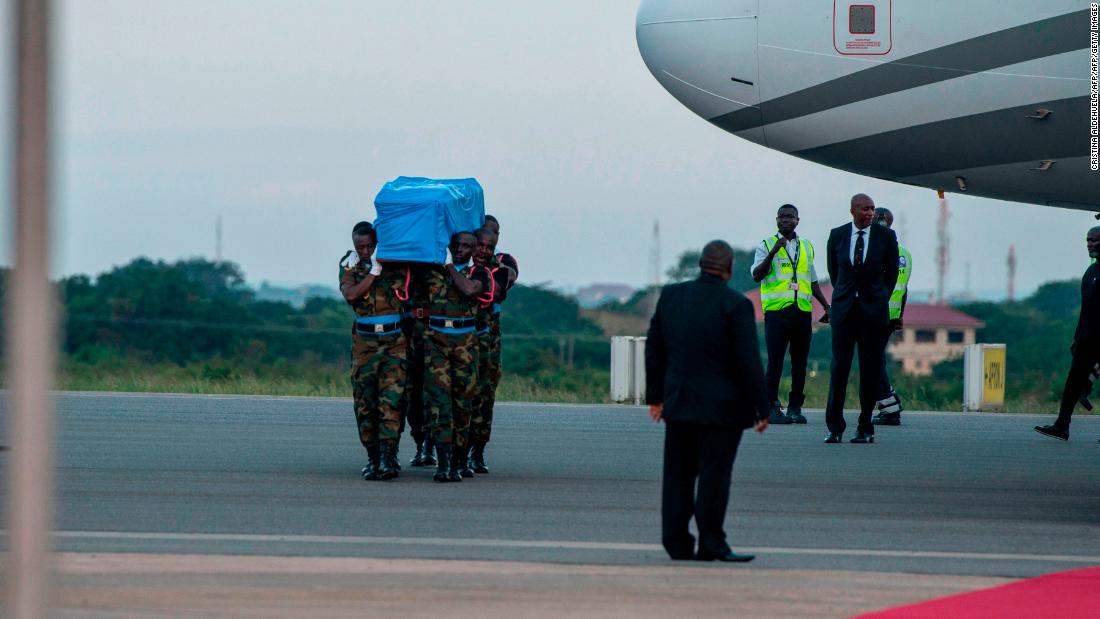
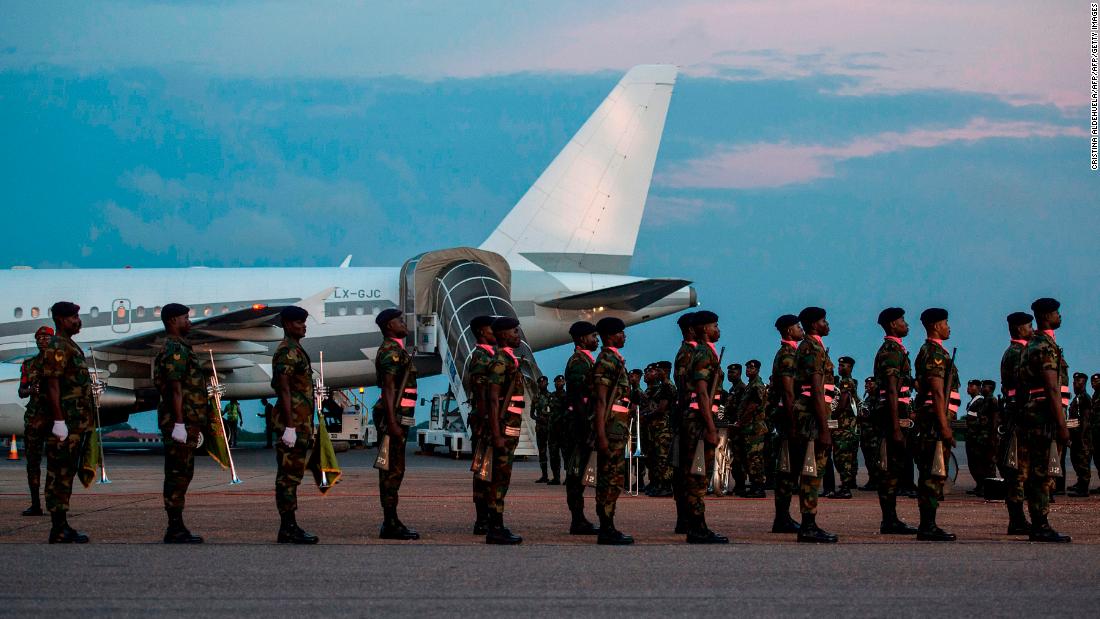
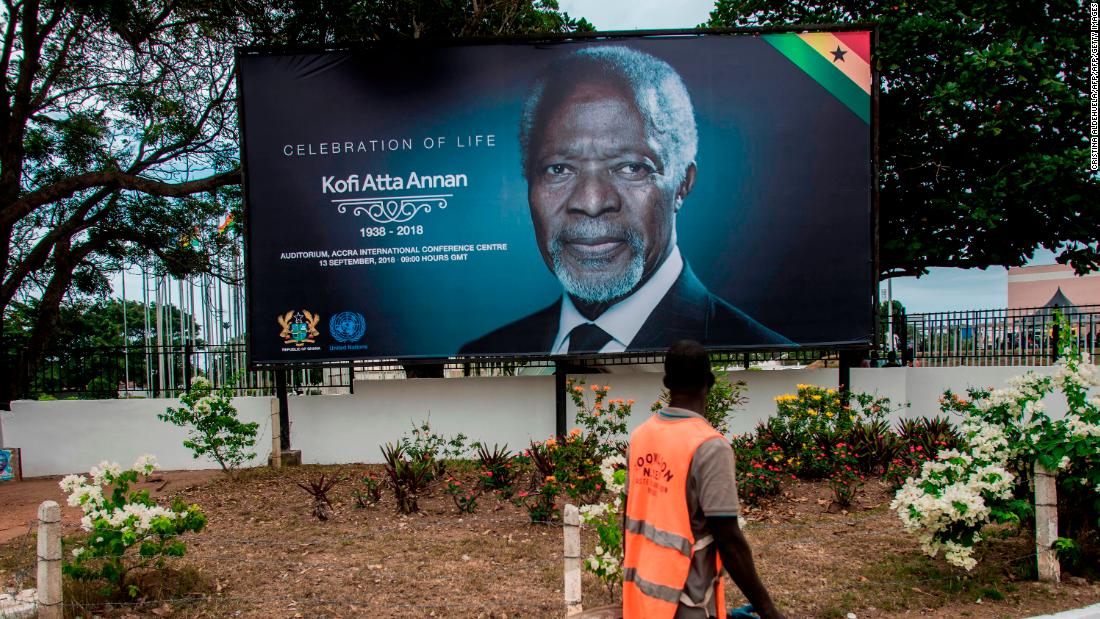
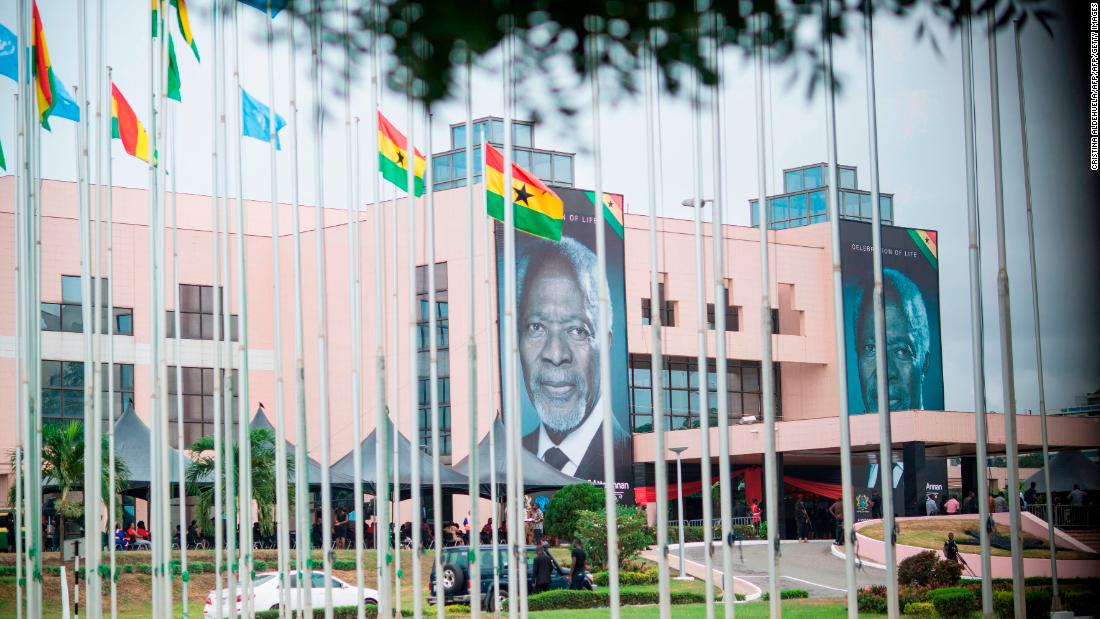
In photos: Ghanians pay last respect to Kofi Annan

Soldiers carry the coffin of late Ghanaian diplomat Kofi Atta Annan on the tarmac of Kotoka International Airport in Accra on September 10, 2018. <br /><br />His body will remain at Accra Conference Center until the burial which will take place on Thursday, September 13 in Accra.<br />Annan was born in Kumasi, Ghana in 1938. He died on August 18, 2018 in Switzerland after a short illness. He was 80. Annan was the seventh Secretary-General of the United Nations, serving from 1997 to 2006.
Soldiers from the Ghanaian military stand to attention as the plane carrying the remains of the late diplomat arrived  on the tarmac of Kotoka International Airport.
Annan's widow Nane Maria Annan (4thL) standing with other family members as Annan's body is welcome and the President of Ghana Nana Akufo-Addo.
A billboard in Accra announcing the celebration of life of Kofi Annan. Funerals are huge affairs in Ghana and are celebrated, particularly when the person has died in old age.
The former UN Secretary General is being given a state funeral on Thursday September 13. There will also be ceremonies at the UN building in New York and Geneva later in September.
Mourners from across the country gathered to pay their last respects to the late diplomat.
Billboards featuring Kofi Annan are displayed at the entrance of Accra International Conference Center where Annan's coffin is lying in state.
Some family members pictured wearing the black and red mourning robes typically worn during funeral rites.
SOURCE

World hunger on the rise for a third year

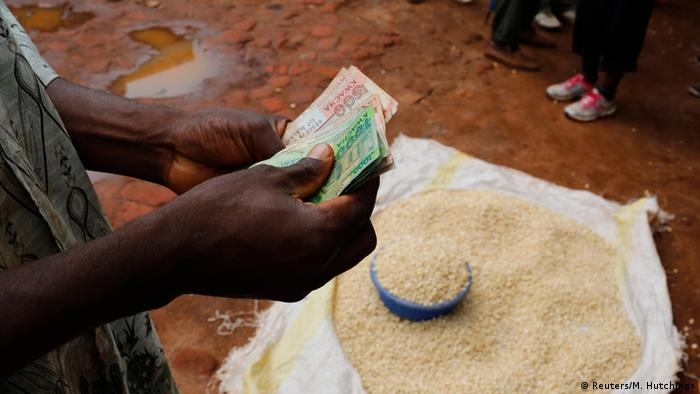
Hands counting money above a sack full of maize (Reuters/M. Hutchings)
Hunger levels have been rising for three years in a row, states a new report by the UN’s Food and Agriculture Organization. In 2017, Africa and South America saw the highest increase.
One in nine people in the world is affected by hunger. That is what the latest report by the UN's Food and Agriculture Organization (FAO) has found. Heavy droughts and conflict are some of the main drivers behind the rise. If the trend continues, the FAO warns, the world will fall far short of achieving the UN's 2030 goal of eradicating hunger.
The report points out that a few advances have been made. Stunting levels in children have for instance decreased and the practice of exclusive breastfeeding has risen in Africa and Asia, while they have declined in North America. DW spoke to Cindy Holleman, a senior economist at the FAO about the report.
DW: In your report,you say that the number of hungry people in the world is rising. But how serious is the situation in Africa?
Cindy Holleman: The key finding that's coming out this year is that indeed world hunger globally is rising for the third year in a row. And this is very worrying because it basically sets us back to the levels of hunger of almost a decade ago. So it is quite an alarming situation. Hunger is continuing to rise especially in Africa. We also see this in South America and a stagnation of hunger in Asia. But Africa keeps coming out on top in terms of the most vulnerable and also the highest rises in terms of hunger.
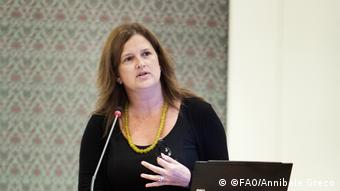
 Cindy Holleman (©FAO/Annibale Greco)
Cindy Holleman is a senior economist at the FAO
----
Why is a situation not changing in Africa?
There are three reasons that are driving the rise in hunger. The first is a conflict which is contributing to the rise in hunger. The second reason is the economic slowdown in some countries. And the third is the increasing climate variability and extremes we see. In the Horn of Africa and other countries, you have both the fact happening. However, the underlying problem with hunger and why we see so much hunger is also poverty, income inequalities and the marginalization of populations. But what's new is we're seeing increasing climate variability and Africa has been hard hit in the last 10 years especially with climate variability and extremes.
Which are the most affected countries in Africa?
If we focus on climate variability in extremes, we see that there is there are a few regions that have been hard hit from this. The El Nino [weather phenomenon] of 2015 and 2016 hit many parts of Africa with very extreme droughts. Southern Africa is a good example. It's an area that's not really affected by conflict like the Horn of Africa but they experience three consecutive years of drought in 2015, 2016 and 2017. It was the worst drought in 35 years and resulted in a problem of the availability of cereals which is quite significant. There was a cereal deficit of almost 8 million tons (8 billion kilograms) in 2016. And then you had rising food prices and as a result, SADC (Southern African Development Community) called out a regional drought emergency which affected 26 million people. But also we see in the Horn of Africa,conflict combined with climate variability. When you have the two together the severity of the situation is quite extreme.
How is insecurity affecting efforts to reach people who need food?
I think one thing I'd like to point to is that we need to take two different approaches. One is, we need to be prepared to do disaster risk reduction and management to help farmers and smallholder populations be able to anticipate extreme weather and also to limit the effects it has on their food income. Sometimes, when it's severe drought, we also need to prepare to respond with food aid and also, more importantly, to help protect their livelihoods so that they can become more resilient to climatic extremes. A need for Africa is that we need to combine disaster risk reduction with climate change adaptation.
What can small-scale farmers do to cut back the losses?
There are a number of different things that can be done and some farmers in Africa are already doing it. For example, in Zambia, we have farmers that are diversifying. Evidence shows that that actually makes them spread the risk and there is a more steady stream of income. There are also examples where you can combine traditional varieties with hybrid varieties to make food crops more resilient. Many countries in Africa are monocultures and so they just rely on maize. It's really important to diversify. But there are many other things that need to be done in terms of ensuring that there are food stocks, community food stocks as well as making sure that the most marginalized and the poor have access to credits so they can invest in their agriculture.
Cindy Holleman is a senior economist, in the Food, Security & Nutrition program of the Food and Agriculture Organization of the United Nations (FAO). She edited the FAO's 2018 report on the "State of Food Security & Nutrition around the World."
Interview: Zipporah Nyambura

Hunger rising with global temperatures, UN report says

Updated 0902 GMT (1702 HKT) September 11, 2018
(CNN)Climate change is having a negative effect on global agriculture and is driving up the number of hungry people around the world, according to the United Nations' 2018 State of Food Security and Nutrition in the World report, released Tuesday.
It found that 821 million people -- one in every nine -- were malnourished in 2017, up from 815 million in 2016, putting at risk the UN's goal of eradicating hunger in the world by 2030.
    There was also limited progress in 2017 in addressing multiple forms of malnutrition, such as child stunting (in which children don't grow properly due to undernourishment) and adult obesity, putting the health of hundreds of millions of people at risk.
    "Hunger has been on the rise over the past three years, returning to levels from a decade ago," the UN agencies responsible for hunger and health said in a statement.
    "This reversal in progress sends a clear warning that more must be done and urgently if the Sustainable Development Goal of Zero Hunger is to be achieved by 2030."
    The UN said the situation is worsening in South America and most regions of Africa, while the trend in undernourishment in Asia seems to be slowing significantly.
    The number of undernourished people in sub-Saharan Africa rose from 181 million in 2010 to almost 222 million in 2016, an increase of 22.6% in six years, and based on current projections, it may have grown to more than 236 million in 2017, the report found.

    Changing weather bad for farming

    The effects of climate variability on rainfall patterns and agricultural seasons, and climate extremes such as droughts and floods, are among the key drivers of the rise in hunger, together with conflict and economic slowdowns, the UN said.
    "If we are to achieve a world without hunger and malnutrition in all its forms by 2030, it is imperative that we accelerate and scale up actions to strengthen the resilience and adaptive capacity of food systems and people's livelihoods in response to climate variability and extremes," the leaders of the five UN agencies involved -- the UN Food and Agriculture Organization, the International Fund for Agricultural Development, the UN Children's Fund, the World Food Programme and the World Health Organization -- said in the report.
    Changes in climate are undermining production of major crops such as wheat, rice and maize in tropical and temperate regions, a trend that is expected to worsen as temperatures become more extreme.
    The number of undernourished people tends to be higher in countries highly exposed to climate extremes, the report said.
    Rising temperatures, the late or early start of rainy seasons and the unequal distribution of rainfall within a season are affecting food production. Other effects include food price hikes and losses in poor farmers' incomes.

    Hungry children

    The report also found limited progress in reducing child stunting.
    Nearly 151 million children younger than 5 were too short for their age due to malnutrition in 2017, compared with 165 million in 2012. Globally, Africa and Asia accounted for 39% and 55% of all stunted children, respectively.
    Africa has seen an upward trend in the number of stunted children, while Asia has experienced the largest relative decrease in stunting prevalence. The confidence limits around the estimates for Oceania are too large to make clear conclusions.
      In 2017, 50.5 million children under five were affected by wasting, which means they are underweight for their age, with 9.0% in West Africa according to UNICEF and 6.3% in Southern Africa and a very high 15.9% in South Asia.
      The UN hunger report makes a number of recommendations, including calls for a shift toward agriculture that is sensitive to nutrition needs and food systems that can provide safe, high-quality food. The report also calls for a stepping-up of efforts to build climate resilience through policies that promote climate change adaptation and mitigation, and disaster risk reduction.

      Monday, 10 September 2018

      Sharon Otieno's family, witnesses seek police protection

      Sharon Otieno
      Joshua Okongo (right) console Sharon Otieno’s mother Melida Auma on September 7, 2018. PHOTO | BENSON MOMANYI | NATION MEDIA GROUP 
      By RUTH MBULA
      More by this Author
      Individuals who came into contact with Rongo University student Sharon Otieno before she was killed by her abductors have been receiving threats from unknown people.
      Also, those who met with Nation reporter Barack Oduor, who was abducted alongside Ms Otieno, have been living in fear following numerous threats and are now pleading for police protection.
      Ms Otieno’s family has not been left out and in addition to grief and shock, they have been constantly under threats from strangers who call them on anonymous numbers. Those who have been threatened have already recorded statements with the police.
      Investigators are following up on the people behind the threats, checking out their calls to know their identity and whether they could have been involved in the murder of the 26-year-old woman as well as possible links to the suspects.
      VESTED INTERESTS
      An uncle to Ms Otieno, who did not want to be named for security reasons, on Sunday said some of their friends and relatives, whom he believes could be emissaries for those behind the murder of his niece, have in a clever manner been urging them to go slow on the issue.
      “Some of our friends, relatives and even mourners have even been asking us not to talk much about the death of our Sharon. Though they pretend to be concerned, I suspect they may be acting on behalf of individuals with vested interests, may be the murderer’s,” he said.
      He, however, said that they will not be cowed and will continue demanding for justice for their slain daughter, who was a second year medical records and information student.
      Mr Joshua Okongo, the family's spokesman, on Friday blamed politicians and journalists for what he termed as blowing out Ms Otieno’s issue out of proportion.
      CONSTANT INTERROGATION
      While speaking to journalists at Ms Otieno's home in Magare village, Homa Bay County, Mr Okongo asked the political class to stay away from the matter.
      At Samanga, the Nation met Mr Gilbert Oyieka, a cousin to a man (name withheld for security purposes), who rescued Mr Oduor after he jumped out of his abductor's vehicle.
      “My cousin does not want to be exposed. We have been seeing vehicles stop around here probably trying to locate him,” he said.
      A manager at Graca Hotel in Rongo, Migori County, lamented that he had not had peace since the kidnapping of the duo because of constant interrogation and threats from various people.

      Sharon’s killers were after baby, autopsy shows

      Sharon Otieno
      Ms Sharon Otieno. She was abducted and murdered in Homa Bay. PHOTO | COURTESY 
      By NATION TEAM
      More by this Author
      The seven-month-old foetus in Ms Sharon Otieno’s womb may have been the key target of her gruesome murder last week, detectives investigating the case believe.
      Director of Criminal Investigations George Kinoti said on Sunday that the killers ensured that they stabbed the baby. An autopsy on the second-year medical records and information student’s body showed that she was strangled and stabbed eight times — four on the back, three on the neck, and once on the left side of her abdomen — leading to excessive bleeding.
      Mr Kinoti said he has watertight evidence that will lead to the successful prosecution of those who planned and executed the kidnapping and subsequent killing of the former Rongo University student.
      Detectives believe a well-organised gang headed by a godfather and comprising an agent and several hitmen carefully planned and executed the double homicide that has shocked the nation.
      GODFATHER
      “The godfather hatched the plan,” said Mr Kinoti. “He is the key person who procured the offence and has a direct link to the agent, who is already in our custody.” He revealed that the agent was well connected to the hitmen who executed the actual kidnapping and murder of the student.
      Ms Otieno was abducted on the evening of Monday last week alongside Nation journalist Barrack Oduor, but the reporter managed to escape by jumping off the kidnappers’ moving vehicle.
      Mr Kinoti, responding to why it had taken long to arrest the culprits, said the investigation entails forensic examination of evidence and studying the complicated web of the underworld.
      “This is an organised criminal ring that requires careful investigation and arrest so that we do not detain the wrong person, and also so that those we arrest do not jeopardise the arrests of others” Mr Kinoti said.
      ABDUCTION
      Investigations have also revealed that more people than previously thought were involved in the abduction and murder.
      “The ring is thickening,” said Mr Kinoti. “The probe is bringing in more and more suspects as the days go by. Even those involved in the remotest way possible are as guilty as the person who actually stabbed Ms Otieno to death.”
      Ms Sharon Otieno
      Ms Sharon Otieno poses for a picture during happier times. She was abducted and killed last week. PHOTO | COURTESY
      Officers privy to the investigation told the Nation that the DCI has dispatched teams to locations where key persons of interest have been located, and that the suspects’ movements are being monitored as the police wait for directions to arrest them systematically.
      “We also have to ensure, albeit in secrecy, that these suspects are safe, including the one that is already in custody, whom we believe is the man at the centre of the whole plot,” an officer who requested anonymity because of the sensitivity of the matter revealed.
      NO SACRED OFFICIAL
      So far only Mr Michael Oyamo, Migori governor Okoth Obado’s aide, has been arrested. Police are also investigating a mysterious man who posed as a soldier in the Kenya Defense Forces, where Mr Oyamo initially worked, in order to gain access to where the suspect is being held.
      His motive was not immediately established, and police said they monitored every move he made within the cell where Mr Oyamo is being held. The KDF distanced itself from the man whom Trucaller, a mobile phone application, identified as Lucas Ouko.
      Meanwhile, Director of Public Prosecutions Noordin Haji said in Mombasa that, in the prosecution of those involved in the killing, “no sacred official” will be left out.
      INVESTIGATIONS
      “No sacred officials will be left,” said Mr Haji. “Whether you are a governor or not you have to face the law. Investigations are ongoing and at the right time when we feel that the governor needs to be arrested, that will definitely be done.
      Investigations sometime take time and people have to be patient, he added during a press briefing at the offices of Mombasa-based NGO, Haki Africa.
      He asked politicians to keep off the matter and wait for the probe to be completed, adding that investigations will take their due course.
      “We do not take orders from anybody, and neither do the IG and the DCI. Politicians should keep off and wait for the investigations to be concluded. Let’s not speculate on the ongoing probe,” said Mr Haji.

      Let investigators find Sharon’s killers, ex-husband appeals


       Bernard Okuta
      Sharon Otieno’s former husband Bernard Okuta. PHOTO | BENSON MOMANYI | NATION MEDIA GROUP 
      By VIVERE NANDIEMO
      More by this Author
      Mr Bernard Okuta, Sharon Otieno’s former husband, has said people should avoid speculating about her death and let the police and other investigating agencies get to the bottom of the murder.
      Ms Otieno, a student at Rongo University, was murdered and her body dumped in a thicket in Homa Bay last week.
      Speaking to the Nation at Rapogi High School in Uriri Sub-county, Migori County on Sunday, Mr Okuta said he believes the killers will be known.
      Although he confirmed that Ms Otieno was married to him, he declined to speak about their marriage, saying that the matter is too emotive for him to comment on.
      When the Nation visited the school, Mr Okuta, a dark-complexioned, middle-aged man about five feet tall was wearing shorts and busy with the students.
      HESITANT
      He was initially hesitant to speak to the media and only spoke after a colleague joined him.
      He was terse but was calm during the interview, which lasted less than 10 minutes.
      “This matter is too emotive for me to comment. If I wanted to comment about it, I would have done so long ago. I would rather leave the matter to the police and other investigators to find out what happened. That is all I can say,” the soft-spoken Mr Okuta said.
      He maintained that the family spokesperson, Mr Joshua Okong’o, had said all that was necessary.
      “What the spokesperson of the family said about the family of the deceased is enough. I will not say anything. Please go and talk to the police for more information,” he said, then left for the staffroom.
      2 DAUGHTERS
      Mr Okong’o had revealed that Ms Otieno had been married to Mr Okuta, and they had a son and two daughters.
      “Her husband is a high school teacher,” Mr Okong’o said, adding that the couple lived in the school compound.
      Mr Okuta comes from Kamagambo in Rongo Sub-county, Migori County, and has been teaching at Rapogi High School for the last four-and-half years.
      SEPARATED
      He graduated from the University of Nairobi with a bachelor’s degree in education in 2013.
      Sources said that Mr Okuta and Ms Otieno separated last year.
      At the time of her death, she was living with her parents in Homa Bay County.
      “The two separated a few months after Sharon joined Rongo University. They separated due to marital problems and Sharon relocated to her parents’ home,” said an employee at the school, who requested anonymity.