Tuesday, 26 May 2020

Lecturers salary in Kenya

Lecturers salaries in Kenya differ on account of experience, level of education, and location.
A lecturer in Kenya typically earns around Ksh179,839 average monthly salary, comprising of housing, transport, and other allowances.
Experience
Experience level is the most important factor in determining a lecturer’s salary because naturally the more years of experience you have, the higher your wage becomes.
A lecturer with less than 2 years of experience earns approximately Ksh97,240 per month.
One with experience level of between 2 – 5 years experience is expected to earn Ksh133,567 per month. This is 37% more than one with less than 2 years experience.
A lecturer with experience level of between 5 – 10 years gets a salary of about Ksh149,914 per month.
Those with between 10 – 15 years experience get a salary equivalent to Ksh182,609 per month, 22% more than a person with 5 – 10 years of experience.
Incase the experience level is between 15 – 20 years, the lecturer is expected to earn monthly salary of Ksh215,304.
Finally, lecturers with more than 20 years of professional experience get a salary of Ksh248,906 per month, 16% more than those with 15 – 20 years of experience.
Education
A much higher education attracts more pay in almost every profession.
Salary by hours worked
The average hourly wage (pay per hour) in Kenya for a lecturer is Ksh1,038.
Lecturer jobs are classified into two categories: salaried jobs and hourly jobs.
Salaried jobs pay a fixed amount of money per month regardless of the hours worked, while hourly jobs pay per the hours worked.
All these, however, differ with the type of the higher education institution (private or public), courses one teaches, location and whether it is a University or College.
Matiang’i
In January 2017, the then Education Cabinet Secretary Dr Fred Matiang’i proposed that University lecturers’ salaries be based on the course taught as a new funding formula for the institutions take effect in the 2018/2019 financial year that started in July same year.
Under the new formula known as differentiated unit cost, public universities would be allocated funds on the basis of their programmes instead of the number of students enrolled.
This was revealed during the first University Chancellors Convention held in Nairobi and presided over by Dr Matiang’i.
Medicine, engineering, architecture, computer science and law lecturers would inturn be paid higher than those in the general humanities and the social sciences.
UASU proposals
In May 2019, Universities Academic Staff Union (Uasu)-Kenya demanded pay hike for lecturers.
According to the Secretary-General Constantine Wasonga, a Kenyan lecturer is paid 50 per cent less what is paid to their Tanzanian counterparts.
Uasu proposed that a graduate assistant now earning Ksh83,598 should earn between Ksh195,656 and Ksh306,006.
Lecturers earning between Ksh99,409 and Ksh140,683 should rise to between Ksh406,050 and Ksh635,097 while senior lecturers earning Ksh112,038 to Ksh159,720 should get Ksh546,163 – Ksh857,384 monthly salary.
Uasu also demanded that associate professors whose basic salary is between Ksh145,441 and Ksh203,605 should start earning Ksh740,020 and Ksh1,157,666 respectively while full professors should get between Ksh999,030 and Ksh1,562,625 from Ksh170,681 to Ksh248,898.
On house allowance, Dr Wasonga says a professor getting Sh73,715 should get Sh250,000 and that of associate professor to rise from Sh66,344 to Sh190,000.
Research study
A research study by a group of experts appointed by a committee of all vice chancellors of public universities in Kenya early 2012, revealed that lecturers of public universities in Rwanda and Tanzania are payed higher salaries compared to those working in Kenya and Uganda.
The study which looked at the 2010 salaries, showed the monthly salary and allowances of a full professor in Kenya are an average of $2,200 compared with $4,900 in Rwanda, $3,200 in Tanzania and $1,150 in Uganda.

Monday, 10 February 2020

THE LOOTING OF KENYA

· Leak of secret report exposes corrupt web
· More than £1bn moved to 28 countries
· Property in London, New York , Australia

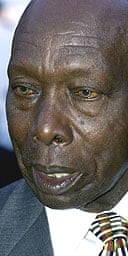
The former Kenyan president Daniel Arap Moi
 The former Kenyan president Daniel Arap Moi. Photograph: Juda Ngwenya/Reuters
The breathtaking extent of corruption perpetrated by the family of the former Kenyan leader Daniel Arap Moi was exposed last night in a secret report that laid bare a web of shell companies, secret trusts and frontmen that his entourage used to funnel hundreds of millions of pounds into nearly 30 countries including Britain.
The 110-page report by the international risk consultancy Kroll, seen by the Guardian, alleges that relatives and associates of Mr Moi siphoned off more than £1bn of government money. If true, it would put the Mois on a par with Africa's other great kleptocrats, Mobutu Sese Seko of Zaire (now Democratic Republic of Congo) and Nigeria's Sani Abacha.
The assets accumulated included multimillion pound properties in London, New York and South Africa, as well as a 10,000-hectare ranch in Australia and bank accounts containing hundreds of millions of pounds.
The report, commissioned by the Kenyan government, was submitted in 2004, but never acted upon. It details how:
· Mr Moi's sons - Philip and Gideon - were reported to be worth £384m and £550m respectively;
· His associates colluded with Italian drug barons and printed counterfeit money;
· His clique owned a bank in Belgium;
· The threat of losing their wealth prompted threats of violence between Mr Moi's family and his political aides;
· £4m was used to buy a home in Surrey and £2m to buy a flat in Knightsbridge.
Kroll said last night it could not confirm or deny the authenticity of the report.
The Kroll investigation into the former regime was commissioned by President Mwai Kibaki shortly after he came to power on an anti-corruption platform in 2003. It was meant to be the first step towards recovering some of the money stolen during Mr Moi's 24-year rule, which earned Kenya the reputation as one of the most corrupt countries in the world.
But soon after the investigation was launched, Mr Kibaki's government was caught up in its own scandal, known as Anglo Leasing, which involved awarding huge government contracts to bogus companies.
Since then, none of Mr Moi's relatives or close allies has been prosecuted. No money has been recovered. Three of the four ministers who resigned after the Anglo Leasing scandal was exposed have since been reinstated.
Last night, the Kenyan government confirmed that it received the Kroll report in April 2004. But Alfred Mutua, the government spokesman, said it was incomplete and inaccurate, and that Kroll had not been engaged to do any further work.
"We did not find that the report was credible. It was based a lot on hearsay." He said the leaking of the report was politically motivated and insisted Kenya was working with foreign governments to recover the stolen money. "Some of the money is in UK bank accounts. We have asked the British government to help us recover the funds, but so far they have refused."
The report was obtained by the website Wikileaks, which aims to help expose corruption. The document is believed to have been leaked by a senior government official upset about Mr Kibaki's failure to tackle corruption and by his alliance with Mr Moi before the presidential election in December.
On Tuesday Mr Moi said he was backing Mr Kibaki for a second term, saying he was disappointed that "selfish individual interests have been entrenched in our society". Mr Moi remains an influential figure in Kenya and his endorsement is expected to go some way to ensuring his successor's re-election.
In the Kroll report the investigators allege that a Kenyan bank was the key to getting vast sums of money of out of the country via its foreign currency accounts. The same bank had already laundered $200m (£100m) on behalf of the late Mr Abacha, with the assistance of a Swiss-based "financier".
"It is believed that twice as much was laundered through the same system by the Mois," the report said.
Kroll confirmed last night that it had previously done work for the Kenyan government. A company spokesman was given extracts of the report seen by the Guardian. "We cannot confirm or deny that this report is what it purports to be," he said. "Nor can we talk about the scope, content or results of any work we have done for the government of Kenya, which remains confidential."
Gideon Moi is an MP and Philip Moi is a businessman. Daniel Arap Moi's spokesman did not return calls last night.

Sunday, 9 February 2020

'Most devastating plague of locusts' in recent history could come within weeks, U.N. warns


By The Associated Press

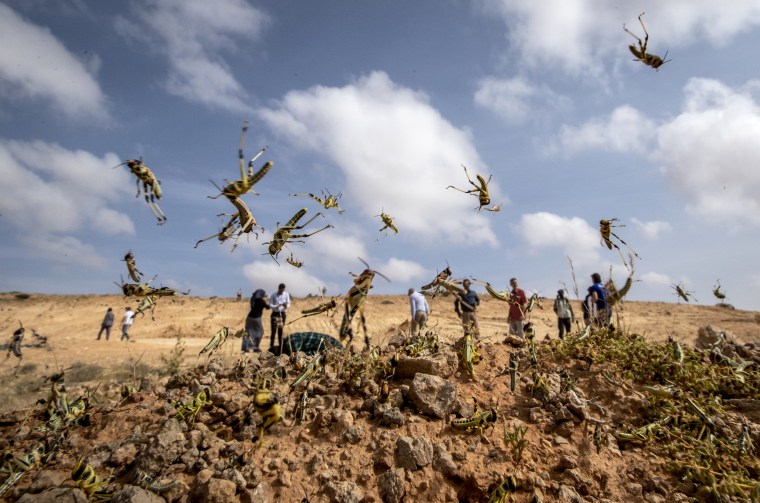
Image: Young locusts jump in the air near Garowe, Somalia, on Feb. 5, 2020.
Young locusts jump in the air near Garowe, Somalia, on Feb. 5, 2020.Ben Curtis / AP
GAROWE, Somalia — At a glance, the desert locusts in this arid patch of northern Somalia look less ominous than the billion-member swarms infesting East Africa in the worst outbreak some places have seen in 70 years.
But their time will come. 

Climate change and al-Shabab extremists contributed to circumstances that could produce crippling swarms of locusts in Somalia and East Africa.


Small and wingless, the hopping young locusts are the next wave in the outbreak that threatens more than 10 million people across the region with a severe hunger crisis.
And they are growing up in one of the most inaccessible places on the planet. Large parts of Somalia south of this semi-autonomous Puntland region are under threat, or held by, the al-Qaida-linked al-Shabab extremist group. That makes it difficult or impossible to conduct the aerial spraying of the locusts that experts say is the only effective control.
Somalia has declared the outbreak a national emergency. Across the region, it has the potential “to be the most devastating plague of locusts in any of our living memories if we don't reduce the problem faster than we're doing at the moment,” U.N. humanitarian chief Mark Lowcock said.
As an armed Somali policeman stood by, experts on Thursday walked across the dry land crawling with the young locusts and explained the threat to come if the world doesn’t act right now.
“The world needs to know this is where it all begins,” said Alberto Trillo Barca, a spokesman for the U.N. Food and Agriculture Organization. “In the next three or four weeks, these nymphs, as we call them, will develop wings.”
Then they are expected to set off for neighboring Kenya and Ethiopia, where a handful of planes spraying pesticide can only do so much if such swarms keep arriving.
Climate experts have pointed to unusually heavy rains, aided by a powerful cyclone off Somalia in December, as a major factor in the outbreak. The locusts were carried in by the storm’s winds from the Arabian Peninsula and parts beyond, and now they are feeding on Somalia's fresh vegetation.
With more rains expected in the region in the coming weeks, the number of locusts if unchecked could grow by up to 500 times by June, when drier weather is expected.
But that drier weather is not necessarily the solution, said Dominique Burgeon, the FAO’s emergency and resilience director.
The density of the locusts is now so high that even normal moisture can lead to another generation, he said.
“We cannot believe in Mother Nature to solve it,” he explained.
Without enough spraying to stop the swarms, the already worrying outbreak could turn into a plague, “and when you have a plague, it takes years to control,” he said.
Against that sweeping outlook, a few masked workers with white protective suits and pesticide containers strapped to their backs stood in the camel-crossed Somali desert, spritzing the thousands of locusts clinging to thorny bushes.
The world's changing climate brings the risk of more cyclones coming in from the warming Indian Ocean off East Africa, climate experts say. With that, the likelihood of further locust outbreaks grows.
The “sort of new normal,” Burgeon said.
And that means Kenya, Ethiopia and other East African countries that rarely see such outbreaks and found themselves largely unprepared for this one could join “frontline countries” in parts of West Africa and the Middle East, experts say. Those countries have well-trained monitoring and prevention systems in place for more frequent locust outbreaks.
The FAO has asked international donors to give $76 million immediately to help control this outbreak. So far $19 million is in hand, Burgeon said.
“The biggest challenge is the scale of the breeding, as you can see all around us,” Barca said. These locusts, he said, will be migrating to southern Somalia and parts of Kenya and Ethiopia just as crops are germinating there.
“If at that time there are huge quantities of locusts around, it will have a devastating impact on the crops,” Burgeon said.
Other East African countries including South Sudan, Eritrea and Djibouti are also at risk, Burgeon said. Millions of people in some of these places are already facing hunger in the wake of civil war or more common challenges such as poverty.
Locusts began to arrive Sunday in Uganda, reaching a village near the Kenyan border, according to Martin Owor, the country's commissioner in charge of disaster preparedness.
The swarm spotted in Amudat district was “certainly big,” and the prime minister was expected to lead an evening emergency meeting on Uganda's first major locust outbreak since the 1960s, Owor said.
Here in rural Somalia, where about 50% of the people depend on animals for their livelihoods, the locusts are eating the pasturage. The animals weaken, their milk decreases and small children, who depend on the milk to survive, suffer skyrocketing malnutrition, the experts said.
Those fighting the locust outbreak may try to negotiate with Somalia's extremist fighters to allow spraying in rural areas where they are active, Burgeon said. Already emergency workers are going in where they can.
In a few weeks the young locusts will shed their skin, said Keith Cressman, a senior locust forecasting officer with the FAO.
“It takes a few days to warm up their wings,” he said. Some test flights follow and they’re on the move.
The locusts at that stage are bright pink and in their most voracious state, like "very hungry teenagers,” Cressman said. By now, many people in Kenya and Ethiopia know them well.
After a month or so, the locusts will be mature adults, ready to reproduce.
Soon after copulating and laying eggs the locusts will die, “but their progeny will be hatching,” Cressman said. “And we have another generation of locusts to contend with, with about another 20-fold increase.”

Friday, 3 January 2020

Teachers face more workload next week

On Monday, schools will usher in a new phase that comes with more disruptive changes brought by the new curriculum.
The implementation of the 2-6-6-3 education system enters its second year next week and the pioneer class will enter upper primary.
They will be left with just two years before completing their primary school.
The unique challenge this time is that unlike the abandoned 8-4-4, learners will have to take 12 subjects, up from six.
 
In total, learners will spend 1,600 hours of learning every week. This is an equivalent of 40 lessons a week
The  is up from 35 lessons in the 8-4-4.
This means the workload in schools is expected to increase two-fold for both learners and teachers.
A circular by Basic Education PS Belio Kipsang to school heads and dated November 7 states that there shall be eight lessons in a day.
It is titled "CBC roll out; implementation guidelines for upper primary Grade 4,5 and 6 further". 
The government will need to ensure the six new subjects that will be introduced are taught despite teacher shortfall.
The new subjects will include Home Science, Agriculture, Creative arts, one optional foreign/indigenous languages, physical health education and pastoral programmes.
Mathematics and Health Education are allocated five lessons each week.
 
Kiswahili, English, and Science will have four lessons each week while Social Studies, Home Science, Agriculture, Religious Education and Creative Arts have three lessons each week.
The foreign subjects will have two weekly lessons and one lesson will be allocated to pastoral programmes.
Foreign languages will be optional while for creative arts, a learner will have to choose from Music, art and craft.
In the circular, the Education PS a said implementation guidelines for foreign and indigenous languages will be issued to the identified public primary schools.
Kipsang states that: "The Education ministry in conjunction with the TSC will identify public primary schools that will offer foreign and indigenous languages."
Kipsang further notes that for the creative arts category, schools will offer one theory lesson and a double lesson for practical activities.
However, the creative arts — comprising home science, music and art and craft—also suffer lack of teachers.
However, sources from the Education ministry indicate that the government banks on teachers to take up extra classes to cover for the expansive learning areas in the new curriculum.
The argument is that teachers with P1 qualification—those who teach primary school—are trained to teach in all learning areas.
The creative arts were previously taught under the 8-4-4 but were later dropped for being perceived inferior and were not examinable.
In preparation of the roll-out, Education CS George Magoha said Education ministry had supplied Grade Four textbooks in 97 per cent of the counties.
He said the remaining counties would be reached before schools open.
Yesterday, Kenya Publishers Association chairman Lawrence Njagi said the books had fully been distributed ahead of Monday school reopening.
Njagi revealed that the publishers in total worked on 14 million textbooks for 12 subjects.
Further, the Teachers Service Commission has trained 106,320 teachers from public and private schools, head teachers and tutors from special needs schools on the CBC to help tackle the implementation in Grade four.
Kenya Parents Association chairman Nicholas Maiyo yesterday said called on the government to increase resources that will support the implementation.

Monday, 30 December 2019

College principals with less than 600 students face sack

Bumula MP Mwambu Mabonga and Bungoma deputy governor Ngome KibananiRECRUITMENT: Bumula MP Mwambu Mabonga and Bungoma deputy governor Ngome Kibanani
Image: JOHN NALANYA

Each TVET head expected to mobilize students or lose the job

In Summary
  • Technical education director Tom Mulati says all training institutions should have over 600 students
  • Calls on students who didn’t join universities to take up science, engineering and technology courses
The government has issued a directive to principals of Technical Vocational Education and Training Institutions with less than 600 students by September 2020 that they will be sacked.
Speaking during the recruitment of students to join various TVETs in Western region from Bumula subcounty, technical education director Tom Mulati said all training institutions should have over 600 students to meet the target set by the government.
“Even if you were posted to a technical training institution yesterday, make sure you have 600 students to protect your job or else you will be sacked. Recruit enough students now,” Mulati said.
He called on the students who didn’t join universities to take up science, engineering and technology courses because they are marketable.
“I encourage many of you to take science, engineering and technology courses because that is where the world is heading to. I ask girls to venture into engineering like building and civil engineering courses, mechanical, electrical engineering for you to succeed. Traditionally they were considered only for men,” he said.
A total of 2,840 students were recruited at Bumula stadium to join various technical institutions and take up different courses as follows:
Sigalagala (258), Sang’alo (399), Bungoma North (28), Bushangala (71), Riat (351), Okame (100), Bumbe (17), Musakasa (1,072), Shambarere (251), Kisiwa (281) and Webuye West (12).
Mulati said fewer girls were enrolling in such courses and called on them to take advantage of the opportunity and favourably compete men.
He pointed out that TVET institutions were offering courses like building and construction, electrical engineering, hair dressing and beauty therapy, food and beverage that can earn one a living right away.
“In TVET institutions we don’t believe that there are no jobs. What we need is an entrepreneurial mind and we can scout for opportunities in good environments,” he said.
Bumula constituency has Musakasa and Maurice Otunga technical training institutes.
Mulati asked secondary school principals to release the certificates of former students whose documents are still held because of fee arrears.
“If you are withholding students' KCSE certificates you are going against the presidential directive and you will be disciplined,” he said.
Mulati stated that the government needs 100 per cent transition of students from secondary schools to universities and colleges.
He stated that the students will benefit from the government funding to enable them carry on with their courses. This includes capitation of Sh30,000 and Helb funding of Sh40,000 yearly.
Bungoma deputy governor Charles Ngome stated that it was only education that would help kick out poverty.
“For you to live a good life, value education. Education defines your future because you will secure a job that will change your fortunes,” he said.
He called on parents to support their children’s talents because they could define their future.
“If your child is an artist, support him. If they are good in anything, let’s market and expose them so that they can land opportunities that can help them in future,” Ngome said.
Bumula MP Mwambu Mabonga said he would make sure recruitment of students is an annual event so that many of them can take TVET courses and better their lives.
“We must empower youths by enrolling them in technical courses or else we are sitting on a volcano that is ready to erupt any time and it will be dangerous to the society,” he said.

If you really fancy a great and working Kenya, do it yourself

LEADERSHIP
The beauty of Mombasa is tainted by uncollected garbage piled on Mombasa Avenue on November 25, 2019. PHOTO | FILE | NATION MEDIA GROUP 
KALTUM GUYO
By KALTUM GUYO
More by this Author
The French rugby team was advised by fans watching from home during the 2019 World Cup in Tokyo that, if they had any hope of advancing in the tournament, they should sack the coach and manage themselves.
The frustration felt by the fans was that despite France being a global rugby powerhouse, its game in the preliminaries was lacklustre due to the coach’s poor decisions.
South Africa and England, who played in the finals, came in with a different mindset and stronger management teams, which played a big role in their advancement.
South Africa took the medal home, lifting the spirits of an economically depressed country. Suffice it to say, France reached the quarter-finals.
Many a times, we leave the main role of managing our lives in the hands of those we elect and give them opportunities, time and again, to do so even when it’s clear that they care less about us but themselves.
What Kenyans perhaps need to realise is that the onus is on them to have clean streets, safer neighbourhoods and excellent hospitals and schools. After all, they are the service users.
ADVERTISEMENT
VOLUNTEERS
I saw first-hand at the Coast General Hospital how Kenyans can get together to support one another in the face of hardship.
Despite what you read in the media, the situation at the hospital, like many others I have visited in the country, is dire.
The shortage of nurses was evident. Instead of waiting for one nurse to go around the 30-plus patients, strangers helped in turning over patients they had never met before, got them in and out of bed, fetched water and food for the immobile ones and ran errands — including processing NHIF for them — for those with no relatives!
I witnessed all this while staying at the hospital with my ailing mother. My contribution was in cleaning a neglected but fully functioning commode.
A few bottles of antiseptics later, it became the wheelchair and moving toilet desperately needed by immobile patients. I hope it is still in use.
In a dogmatic country, citizens would always get excuses as to why they feel neglected.
Either funds are unavailable from the same people stealing them or use state machinery to silence those critical of the failures in service delivery.
QUESTIONABLE LEADERSHIP
That apart, it’s still important to realise that citizens are the architects of their own destiny and better communities.
Hence, if Kenyans, indeed, wish for a greatly functional Kenya, they need to take the reins for socio-economic success by pulling together to make sure schools are equipped for their children and hospitals cleaned up ready for their use.
Looking at how our leaders have let us down, it’s easy to see that politics is overrated.
Many of our countrymen and women get maimed, tortured and killed in the name of politics but, after the election violence, all Kenyans experience poverty spikes, wanting healthcare for the poor, insecurity and runaway corruption.
One is then left wondering what Kenyan politics is for. What or whom are Kenyan leaders leading in the face of economic despair?
With the confusing Building Bridges Initiative (BBI) report, ‘Handshake’ malarkey and big buck projects over lack of investment in social programmes, I’m no longer sure whether the country is coming or going.
SUCCESS STORIES
Amid all the negative news and toxic politics, however, positive stories appear from somewhere to warm our hearts.
Teacher Tabichi quietly put his head down and taught his pupils while sacrificing his salary to buy them study materials.
This, in an area supposedly with an MP, who should have used CDF funds to support the school in the first place!
Athletes like Eliud Kipchoge become the icons and ambassadors for the good and great that Kenya has to offer.
All the leaders are left to do is hang on the tailcoats of self-made heroes and bask in the glory of something they never invested in.
‘Stadiums’ has become a byword for empty election promises and not a springboard for sporting prowess.
Perfect communal spirit by Kenyans is found on social media through KoT (Kenyans on Twitter), whom I give my alternative Nobel Prize.
They have been resolute in fighting injustice with the use of just a keyboard. They even shut up Donald Trump (for crying out loud!) following his ‘hotbed of terror’ comment on Kenya.
BE PROACTIVE
If I had a second alternative Nobel, I would give it to lone nurses and doctors who turn up and care for patients in warlike situations in our hospitals with just basic resources at hand.
As we go into 2020 and trudging towards 2022, it’s important for us to learn not to be followers but leaders — that is, of our lives.
Don’t ask what the country can do for you; ask what you can do for your communities, and yourself, to improve the quality of life.
Let us learn to sack the ineffective coach and manage our lives by being the best leaders and elect the leaders that can lead. In the meantime, Happy New Year!
Ms Guyo is a legal researcher. kdiguyo@gmail.com @kdiguyo

Glowing tributes at burial of NCIC vice-chair Fatuma Tabwara


Fatuma Tabwara buriaMourners carry the body of Ms Fatuma Tabwara, who was the vice chair of the National Cohesion and Integration Commission (NCIC), during the burial at Kombani in Matuga, Kwale County, on December 30, 2019. PHOTO | BRIAN MWANGI | NATION MEDIA GROUP 
By MISHI GONGO
More by this Author
Leaders gave glowing tributes in honour of NCIC vice-chairperson, Ms Fatuma Tabwara, at her funeral in Kwale County on Monday.
Ms Tabwara was pronounced dead at Diani Beach Hospital at 10am on Sunday, after collapsing at a relative's wedding in the county.
She is survived by her husband, Mr Fuad Said Gofwa, two daughters and two sons.
VIPs
Commissioners of the National Cohesion and Integration Commission (NCIC) were among those who attended the burial at Kombani in Matuga.
Also present were Agriculture Principal Secretary Hamadi Boga, Governor Salim Mvurya, Commissioner Salim Mrina, County Commissioner Karuku Ngumo, Matuga member of Parliament Kassim Tandaza and Mudzo Nzili, the former chairman of the Kenya National Union of Teachers.
Kwale Governor Salim Mvurya speaks at the
Kwale Governor Salim Mvurya speaks at the burial of Ms Fatuma Tabwara, who was the vice chair of the National Cohesion and Integration Commission (NCIC), at Kombani in Matuga, Kwale County, on December 30, 2019. PHOTO | BRIAN MWANGI | NATION MEDIA GROUP
ICON
Governor Mvurya described Ms Tabwara as a great leader and an icon in the Kwale community.
"She always preached peace and unity. Let us not forget what Ms Tabwara always reminded us - to avoid joining movements that seek to divide us,” he said.
He further urged the people to elect leaders based on their leadership skills, not tribes and political affiliations. 
Mourners are pictured at the burial of Ms
Mourners are pictured at the burial of Ms Fatuma Tabwara, who was the vice chair of the National Cohesion and Integration Commission (NCIC), at Kombani in Matuga, Kwale County, on December 30, 2019. PHOTO | BRIAN MWANGI | NATION MEDIA GROUP
HUGE GAP
Commissioner Wambui Nyutu, who read the NCIC's eulogy, said Ms Tabwara "left a gap that no one can fill".
"It will take us a long time to come to terms with this [shocking] loss,” she said.
Ms Tabwara served at the commission for just two months but made significant contributions.
Ms Nyutu described her as a true patriot who gave all her time and expertise in serving Kenyans, both at the grassroots and national levels, irrespective of their ethnic, religious and racial backgrounds.
“She was a resourceful person whose passion was to nurture the youth and women in all aspects of integration, peaceful coexistence as well as cohesion. Kwale County, our hearts and prayers are with you at this difficult time," she said.
Quoting US ambassador Adlai Stevenson II on a man and his contributions, she added, "It is not in the years that life counts; it is the life in the years."